



P2Y Receptor
P2Y receptors are a class of G protein-coupled receptors (GPCRs) activated by extracellular nucleotides (ATP, UTP, and UDP). There are eight mammalian P2Y receptor subtypes (P2Y1, P2Y2, P2Y4, P2Y6, P2Y11, P2Y12, P2Y13, and P2Y14). The P2Y receptors are expressed in various cell types and play important roles in physiology and pathophysiology including inflammatory responses and neuropathic pain.
The P2Y family can be further divided into a subfamily of five P2Y1, P2Y2, P2Y4, P2Y6, and P2Y11Rs (“P2Y1-like”) that stimulate phospholipase C (PLC) through Gq protein and a second subfamily of P2Y12, P2Y13, and P2Y14Rs (“P2Y12-like”) that inhibit adenylate cyclase through Gi protein. Other effector pathways have been documented, such as coupling of the P2Y11R to Gs as well as to Gq in some cells to induce stimulation of cyclic AMP production.
P2Y Receptor Isoform Specific Products
All Product Categories
-
P2Y Receptor Inhibitors
(58)
View all products
-
P2Y Receptor Agonists
(50)
View all products
-
P2Y Receptor Antagonists
(85)
View all products
-
P2Y Receptor Activators
(11)
View all products
-
P2Y Receptor Modulators
(4)
View all products
-
P2Y Receptor Controls
(3)
View all products
-
P2Y Receptor Ligands
(3)
View all products
-
P2Y Receptor Related Products (229)
Related Products (229)

-
Antibodies (2)
-
P2Y Receptor Isoform Comparison
-
Prasugrel (Maleic acid)
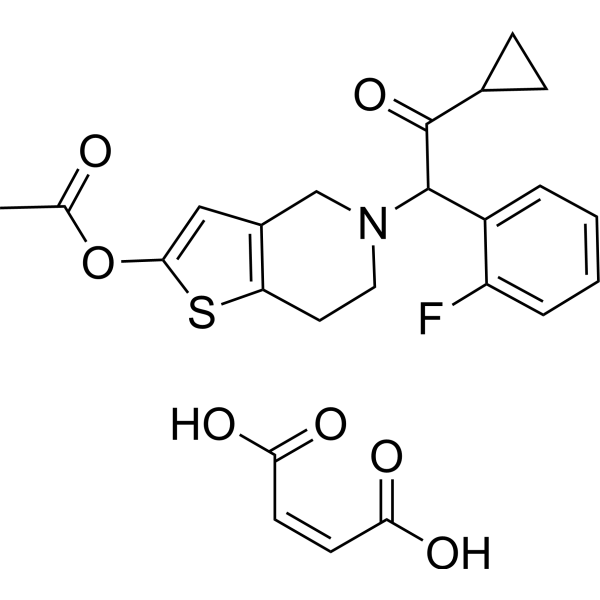 0 ImagesCat. No.: HY-15284BCAS No.: 389574-20-3Synonyms: PCR 4099 (Maleic acid)Prasugrel (PCR 4099) Maleic acid is a thienopyridine and proagent, inhibits platelet function. Prasugrel Maleic acid is an orally active and potent P2Y12 receptor antagonist, and inhibits ADP-induced platelet aggregation.
-
Cangrelor tetrasodium (Standard)
 0 ImagesSynonyms: AR-C69931MX tetrasodium (Standard)Cangrelor (tetrasodium) (Standard) is the analytical standard of Cangrelor (tetrasodium). This product is intended for research and analytical applications. Cangrelor tetrasodium, an adenosine triphosphate analogue, is a reversible and selective platelet P2Y12 antagonist, with prompt and potent antiplatelet effects. Cangrelor tetrasodium directly blocks adenosine diphosphate (ADP)-induced activation and aggregation of platelets. Cangrelor tetrasodium is also a nonspecific GPR17 antagonist.
-
Adenosine 3'-phosphate 5'-phosphosulfate triethylamine
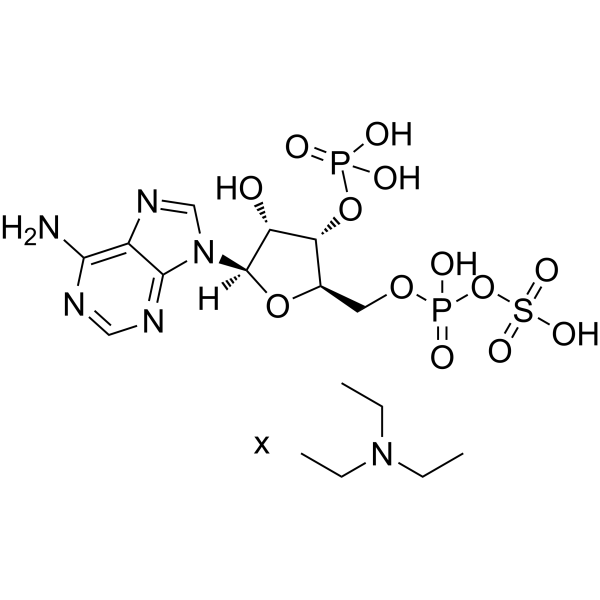 0 ImagesCat. No.: HY-N9422CAS No.: 936827-87-1Adenosine 3'-phosphate 5'-phosphosulfate triethylamine, an adenine nucleotide derivative, is a selective P2Y1 antagonist with no effect on P2Y2, P2Y4, or P2Y6 receptors. Adenosine 3'-phosphate 5'-phosphosulfate triethylamine can competitive inhibit ADP-induced platelet aggregation, as well as the ability of ADP to cause shape change and increases in Ca2+ in platelets, but had no effect on the inhibition of stimulated adenylate cyclase by ADP. Adenosine 3'-phosphate 5'-phosphosulfate triethylamine is a co-substrate used for the sulfonation of glycans. Adenosine 3'-phosphate 5'-phosphosulfate triethylamine can be used for Golgi-resident PAP-specific 3'-phosphatase-coupled sulfotransferase assays, which as donor substrate to transfer a sulfonate group.
-
(±)-Clopidogrel-d7 sulfate
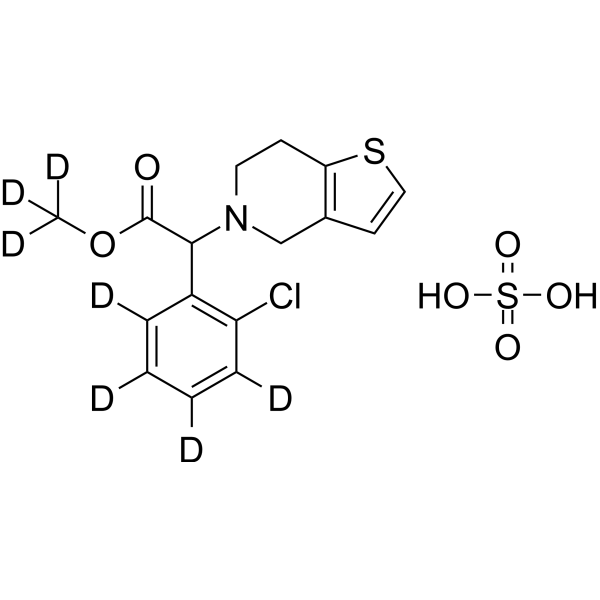 0 ImagesCat. No.: HY-15283ASCAS No.: 1346598-07-9Synonyms: (±)-Clopidogrelum-d7 sulfate(±)-Clopidogrel-d7 (sulfate) is the deuterium labeled (±)-Clopidogrel sulfate.
-
Uridine 5'-O-thiodiphosphate
 0 ImagesCat. No.: HY-137608CAS No.: 221010-51-1Synonyms: UDP-β-SUridine 5'-O-thiodiphosphate (UDP-β-S) is a P2Y6 receptor agonist with an EC50 of 25 nM. Uridine 5'-O-thiodiphosphate resists degradation by extracellular nucleotidases and stimulates the accumulation of inositol phosphates. Uridine 5'-O-thiodiphosphate stimulates contractile responses in endothelium-denuded rat mesenteric arteries. As a mitogen, Uridine 5'-O-thiodiphosphate stimulates DNA synthesis, [3H] thymidine incorporation, protein synthesis, [3H]leucine incorporation, and increases the number of vascular smooth muscle cells. Uridine 5'-O-thiodiphosphate can be used in the research of cardiovascular diseases such as atherosclerosis.
-
2-MeS-ATP
 0 ImagesCat. No.: HY-137418CAS No.: 43170-89-4Synonyms: 2-Methylthio-ATP2-MeS-ATP (2-Methylthio-ATP) is an analog of adenosine nucleotides and acts as a P2Y purinergic receptor agonist specific for adenosine nucleotide activation. 2-MeS-ATP is also able to inhibit the release of toxic mediators from macrophages stimulated by endotoxin (LPS). 2-MeS-ATP can be used in the study of endotoxin shock and inflammatory diseases.
-
Chloramphenicol succinate sodium (Standard)
 0 ImagesCat. No.: HY-N7114ARCAS No.: 982-57-0Chloramphenicol succinate sodium (Standard) is the analytical standard of Chloramphenicol succinate sodium. This product is intended for research and analytical applications. Chloramphenicol succinate sodium is a prodrug of Chloramphenicol (HY-B0239), acting as a P2Y14R inhibitor with an IC50 of 1.585 nM. Chloramphenicol succinate sodium serves as a competitive substrate and inhibitor of succinate dehydrogenase (SDH), which may account for its toxicity. Chloramphenicol succinate sodium exerts a significant inhibitory effect on colitis. Chloramphenicol succinate sodium can be used in research related to myelosuppression, gray baby syndrome, aplastic anemia, bacterial meningitis and inflammatory bowel disease.
-
Uridine-5'-diphosphate disodium salt (Standard)
 0 ImagesSynonyms: UDP disodium salt (Standard)Uridine-5'-diphosphate (UDP) disodium salt (Standard) is the analytical standard of Uridine-5'-diphosphate disodium salt (HY-W010832). This product is intended for research and analytical applications. Uridine-5'-diphosphate disodium salt is an important nucleotide made of uracil, ribose, and a pyrophosphate group. Uridine-5'-diphosphate disodium salt is a potent, selective human P2Y6 receptor native agonist (EC50 = 300 nM; pEC50 = 6.52). Uridine-5'-diphosphate disodium salt, an endogenous metabolite, catalyzes the glucuronidation of a wide array of substrates and is used in nucleic acid (RNA) biosynthesis.
-
Adenosine 3'-phosphate 5'-phosphosulfate lithium
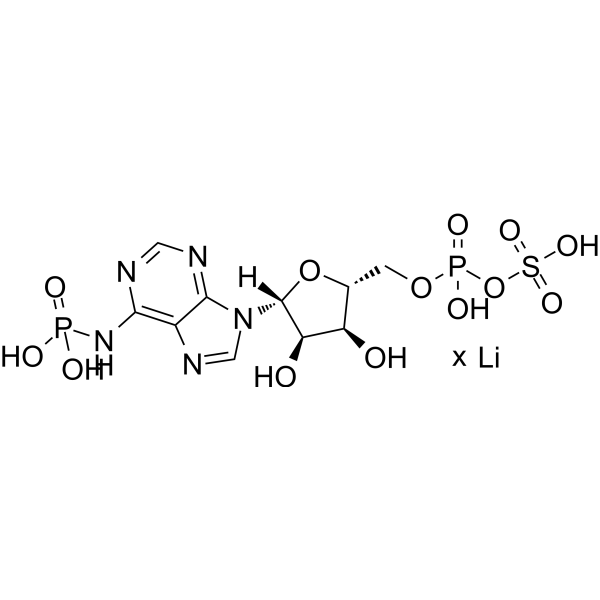 0 ImagesCat. No.: HY-W250153CAS No.: 109434-21-1Adenosine 3'-phosphate 5'-phosphosulfate lithium, an adenine nucleotide derivative, is a selective P2Y1 antagonist with no effect on P2Y2, P2Y4, or P2Y6 receptors. Adenosine 3'-phosphate 5'-phosphosulfate lithium can competitive inhibit ADP-induced platelet aggregation, as well as the ability of ADP to cause shape change and increases in Ca2+ in platelets, but had no effect on the inhibition of stimulated adenylate cyclase by ADP. Adenosine 3'-phosphate 5'-phosphosulfate lithium is a co-substrate used for the sulfonation of glycans. Adenosine 3'-phosphate 5'-phosphosulfate lithium can be used for Golgi-resident PAP-specific 3'-phosphatase-coupled sulfotransferase assays, which as donor substrate to transfer a sulfonate group.
-
Prasugrel hydrochloride (Standard)
 0 ImagesCat. No.: HY-15284ARCAS No.: 389574-19-0Synonyms: PCR 4099 hydrochloride (Standard)Prasugrel (hydrochloride) (Standard) is the analytical standard of Prasugrel (hydrochloride). This product is intended for research and analytical applications. Prasugrel hydrochloride (PCR 4099 hydrochloride), a thienopyridine and proagent, inhibits platelet function. Prasugrel hydrochloride is an orally active and potent P2Y12 receptor antagonist, and inhibits ADP-induced platelet aggregation.
-
2-Thio-UTP
 0 ImagesCat. No.: HY-116307CAS No.: 35763-29-22-Thio-UTP is a selective P2Y2 inhibitor with an EC50 value of 50 nM. 2-Thio-UTP reduces pro-fibrotic gene expression and protein α-smooth muscle actin. 2-Thio-UTP has the potential for the research of calcific aortic valve stenosis (CAVS) .
-
ATPγS tetralithium salt (Standard)
 0 ImagesCat. No.: HY-108666RCAS No.: 93839-89-5Synonyms: Adenosine-5'-O-(3-thiotriphosphate) tetralithium salt (Standard); Adenosine 5'-[γ-thio]triphosphate tetralithium salt (Standard)ATPγS tetralithium salt (Standard) is the analytical standard of ATPγS (tetralithium salt) (HY-108666). This product is intended for research and analytical applications. ATPγS (tetralithium salt) is a P2Y11 receptor agonist, an antioxidant and a neuroprotective agent. ATPγS (tetralithium salt) can be used as a substrate for the nucleotide hydrolysis and RNA unwinding activities of eukaryotic translation initiation factor eIF4A. ATPγS (tetralithium salt) is active in ATP hydrolysis.
-
5'-UMPS
 0 ImagesCat. No.: HY-131822CAS No.: 15548-52-4Synonyms: Uridine-5'-O-monophosphorothioate5'-UMPS (Uridine-5'-O-monophosphorothioate) is a P2Y14 receptor agonist. 5'-UMPS can induce HeLa cell growth slightly.
-
PSB-0739 (Standard)
 0 ImagesCat. No.: HY-108660RCAS No.: 1052087-90-7PSB-0739 (Standard) is the analytical standard of PSB-0739 (HY-108660). This product is intended for research and analytical applications. PSB-0739 is a high-affinity potent, competitive, nonselective platelet P2Y12 receptor antagonist with a Ki values of 24.9 nM. The P2Y12 receptor plays a crucial role in platelet aggregation. Antithrombotic effect.
-
BX 667
 0 ImagesCat. No.: HY-111064CAS No.: 937395-08-9BX 667 is an orally active reversible P2Y(12) receptor antagonist. BX 667 attenuates thrombosis.
-
Sp-ATPαS
 0 ImagesCat. No.: HY-137626CAS No.: 58976-48-0Sp-ATPαS is a regulator of ATP-binding proteins. Sp-ATPαS is a competitive antagonist of the human P2Y1 receptor, which can inhibit the calcium signal induced by ADP. Sp-ATPαS is metabolically more stable than ATP. Sp-ATPαS can be used to study the binding patterns of metals and nucleotides in enzymatic reactions.
-
MRS2298
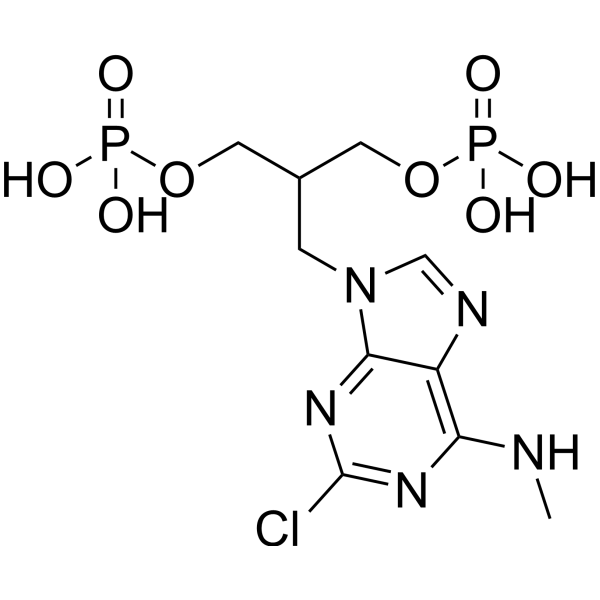 0 ImagesCat. No.: HY-113723CAS No.: 491611-43-9MRS2298? is a potent acyclic P2Y1 receptor antagonist with a Ki of 29.6 nM. MRS2298 inhibits the ADP-induced aggregation of human platelets with an IC50 of 62.8 nM. MRS2298 inhibits Ca2+ rise in platelets with an IC50 of 810 nM.
-
PPTN (Standard)
 0 ImagesCat. No.: HY-110322ARCAS No.: 1160271-30-6PPTN (Standard) is the analytical standard of PPTN (HY-110322A). This product is intended for research and analytical applications. PPTN, a chemical probe, is a potent, high-affinity, competitive and highly selective P2Y14 receptor antagonist with a KB value of 434 pM. PPTN exhibits no agonist or antagonist effect at the P2Y1, P2Y2, P2Y4, P2Y6, P2Y11, P2Y12, or P2Y13 receptors. Anti-inflammatory and immune activity.
-
4-Thiouridine 5′-triphosphate tetrasodium
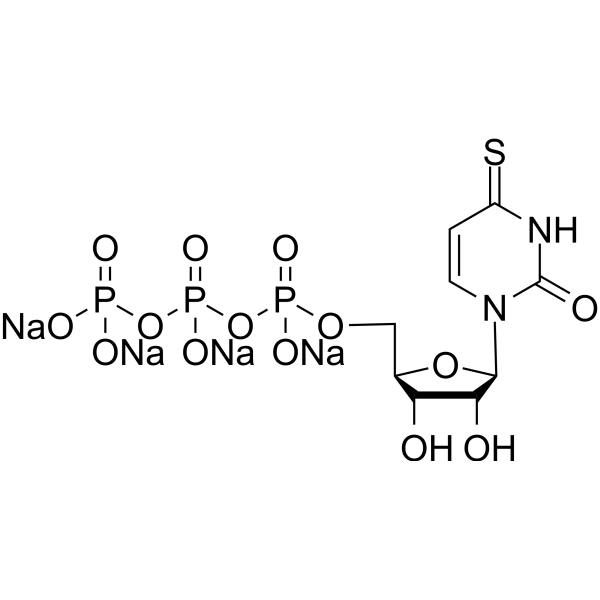 0 ImagesCat. No.: HY-154840ACAS No.: 68507-49-3Synonyms: 4-Thio-UTP tetrasodium4-Thiouridine 5′-triphosphate (4-Thio-UTP) tetralithium (Compound 15) is a UTP analog and potent P2Y2 and P2Y4 agonist with EC50 values of 35 and 350 nM for hP2Y2 and hP2Y4, respectively. 4-Thiouridine 5′-triphosphate tetralithium can be used in cross-linking experiments and transcriptional complex labeling studies.
-
PIT (Standard)
 0 ImagesCat. No.: HY-108662RCAS No.: 56583-49-4Synonyms: 2,2'-Pyridylisatogen tosylate (Standard)PIT (Standard) is the analytical standard of PIT (HY-108662). This product is intended for research and analytical applications. PIT (2,2'-Pyridylisatogen tosylate) is a selective and non-competitive antagonist of P2Y1 receptor with an IC50 value of 0.14 μM for human P2Y1 receptor. PIT antagonizes P2Y1 receptor signaling without affecting nucleotide binding. PIT is an irreversible antagonist of responses to ATP at metabotropic purinoceptors (of the P2Y family) in some smooth muscles. PIT can be used for the research of chronic bronchitis and asthma.




